
Block Paving vs Resin Bound Driveways — Which Is Right for Your Plymouth Home?
These are the two most popular driveway surfaces in Plymouth right now, and choosing between them is genuinely not straightforward. They look different, behave differently, cost differently, and suit different properties and lifestyles. The good news is that there is usually a clear answer for most sites once you know what to look for.
At Landart Drives & Patios we install both, and we have no interest in steering you towards one or the other. Our job at the free survey is to understand what you actually want from your driveway and recommend the surface that best fits your property, your budget, and the way you will use the space. What follows is the same honest comparison we go through at the kitchen table during every survey where a customer has not yet decided.
How They Are Made — and Why It Matters
Understanding the basic construction of each surface explains why they behave the way they do.
Block paving is made from individual concrete or clay blocks — typically 60mm to 80mm thick — laid in a pattern on a compacted sand or mortar bedding course over a hardcore sub-base. The blocks interlock in the chosen pattern and are jointed with kiln-dried sand. The surface is made of discrete units. It can be lifted, repaired, and relaid in sections without touching the rest of the driveway.
Resin bound is a continuous surface created by machine-mixing natural aggregate with a clear UV-stable polyurethane resin and trowelling the mix onto a macadam base at a consistent depth of around 15 to 18mm. Once cured, it forms a single seamless matrix. It cannot be lifted in sections — it is one unified piece across the full area.
This structural difference drives most of the practical differences between them.
Appearance — Which Looks Better?
This is largely subjective, but there are some general patterns worth knowing about Plymouth specifically.
Resin bound gives a smooth, seamless finish with a consistent texture across the whole surface. It looks contemporary and clean, suits modern properties and new builds well, and gives a sense of spaciousness because there are no visible joints breaking up the surface. It is the surface most often seen on property programme renovations and in high-end new build developments.
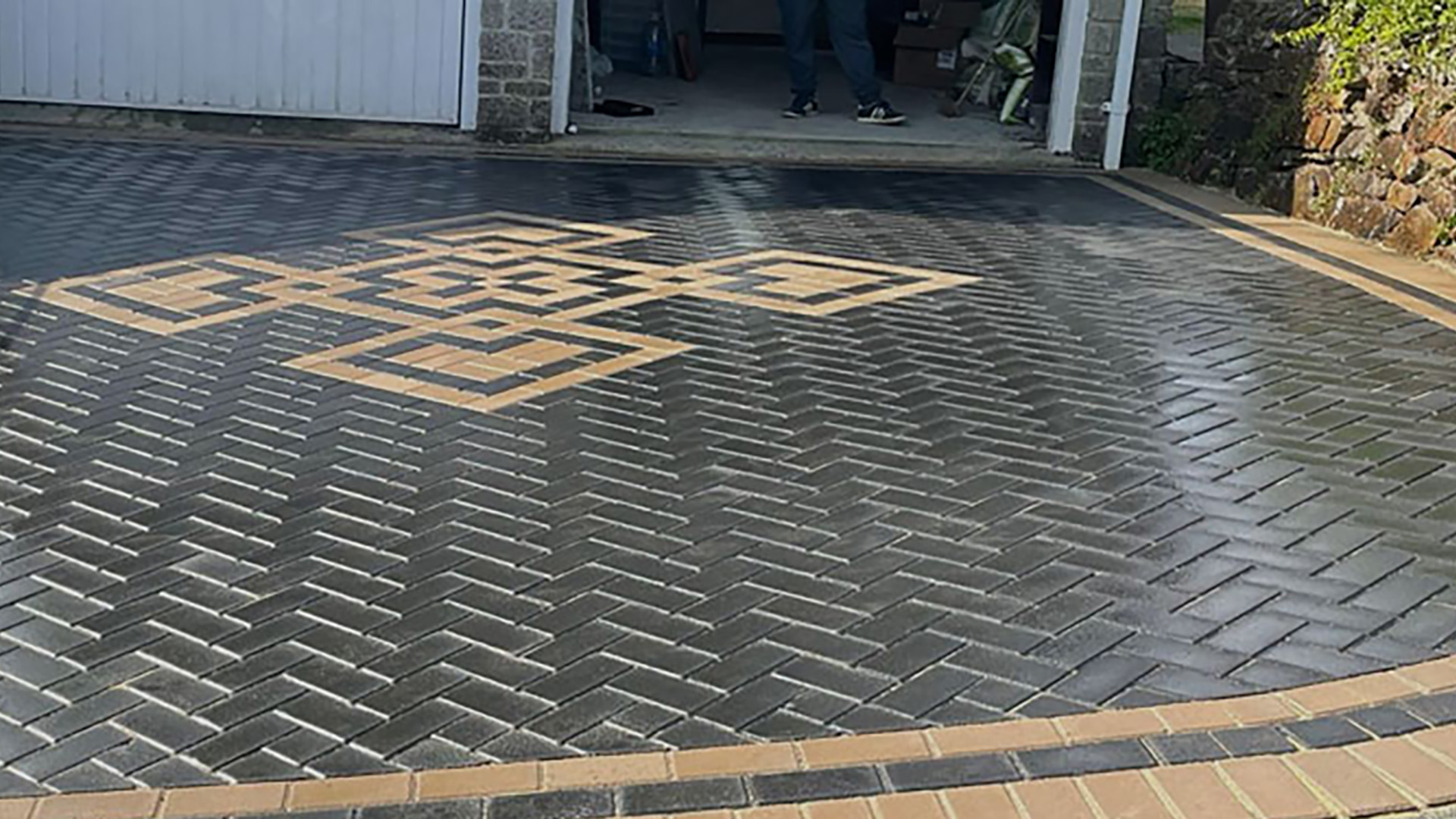
Block paving offers far more variety. The range of patterns — herringbone, basketweave, stretcher bond, feature circles, contrasting borders — combined with the colour ranges from Marshalls and Bradstone means no two block paving driveways need look the same. Block paving works as well on a 1930s semi in Peverell as it does on a contemporary detached in Derriford, because the design can be adjusted to complement the architecture. It gives a traditional, crafted feel that resin bound does not replicate.
In our experience across Plymouth, resin bound tends to be the stronger choice where the brief is modern and minimal. Block paving tends to be the stronger choice where the property has character features — period architecture, brick, stone — that benefit from a surface with its own texture and detail.
Drainage and Planning Permission in Plymouth
Both surfaces handle drainage well, but in different ways — and this matters for planning.
Resin bound is fully permeable by design. Water passes directly through the surface into the sub-base. This makes it SuDS compliant without any additional drainage provision, which means no planning permission is required for front garden driveways under permitted development rules in England.
Block paving can be permeable or impermeable depending on how it is specified. Installed with permeable jointing sand and a free-draining sub-base — which is how we specify it as standard for all front garden driveways in Plymouth — it also satisfies the SuDS drainage requirement and falls within permitted development. Block paving installed with solid mortar joints is impermeable and may require planning permission for a front garden driveway.
In practice, both surfaces can be used for front garden driveways in Plymouth without planning permission when correctly specified. For more detail on what triggers a planning application, see our guide on planning permission for driveways in Plymouth.
Durability and Lifespan
Both surfaces are durable when correctly installed. The sub-base is the more important factor in both cases — a perfectly installed surface on a poorly prepared sub-base will fail; a modest surface on an excellent sub-base will outlast most expectations.
Block paving typically lasts 20 to 30 years or more. It handles vehicle loads well, is resistant to Plymouth’s freeze-thaw conditions when correctly jointed, and tends to improve in appearance as it weathers and settles into the landscape of the property.
Resin bound typically lasts 15 to 25 years. UV stability is an important factor in Plymouth, where south-facing driveways receive significant sun exposure. We use UV-stable polyurethane resin as standard, which prevents yellowing and surface degradation over time. Lower-grade resins can discolour within a few years in a coastal environment like Plymouth.
If longevity is the primary driver, block paving has a slight advantage in expected lifespan. If low maintenance over the surface’s life is the priority, resin bound has the edge.
Maintenance — What Each Surface Needs
Block paving maintenance
Block paving requires more ongoing attention than resin bound. Joints will eventually thin and need re-sanding, usually every three to five years following jet washing. Weed seeds can establish in joints if the surface is not cleaned regularly. The surface benefits from sealing every three to five years to enhance colour, resist staining, and inhibit weed growth. Individual blocks that sink or rock need prompt attention to prevent water ingress under the surface.
None of this is burdensome, but it is ongoing. If you prefer a driveway that can be largely ignored once it is laid, block paving is not the lower-maintenance option.
Resin bound maintenance
Resin bound needs very little. Brush off leaves and debris regularly to prevent staining and keep the drainage pores clear. Jet wash once a year using low pressure. No sealing required, no re-jointing, and very little weed growth because there are no joints for seeds to establish in. Beyond the annual clean, a resin bound driveway in Plymouth requires minimal attention for the majority of its lifespan.
Repairability
This is where the two surfaces diverge most significantly, and it matters more than most people consider at the buying stage.
Block paving can be repaired invisibly. If a utility company needs to access a drain beneath your driveway, or a vehicle drops something heavy that damages the surface, or ground movement causes a section to sink — the affected blocks can be lifted, the sub-base corrected, and the blocks relaid. Done well, the repair is invisible. Done at any point in the driveway’s life. This repairability is a genuine long-term advantage, particularly in Plymouth where gas and water utility access to front garden driveways is common in older residential areas.
Resin bound cannot be repaired as invisibly. Sections can be cut out and replaced, but colour-matching a fresh resin mix to a weathered surface is difficult and the joint between old and new will be visible. Larger damage repairs are more straightforward, but patch repairs on resin bound are rarely as invisible as block paving repairs done by a good team.
Cost Comparison
Both surfaces vary in cost depending on size, groundwork, and specification. As a general guide for Plymouth driveways:
Resin bound is typically priced similarly to mid-range block paving on a per-square-metre basis. The preparation requirements are similar. Premium aggregate choices in resin bound can push the cost above equivalent block paving. Budget block paving using lower-grade materials will generally be cheaper than resin bound, but we do not install budget-grade block paving — we install Marshalls and Bradstone, which are premium manufacturer ranges.
For most Plymouth driveways, the cost difference between a good block paving installation and a good resin bound installation is not dramatic. The better question is which surface is right for the property and the customer’s preferences — not which one is cheaper.
We provide free, no-obligation written quotes for both surfaces, so you can compare them accurately for your specific driveway. Read our Plymouth driveway cost guide for more context on what drives costs for either surface.
Summary — Which Should You Choose?
Choose block paving if:
- Your property is period, traditional, or has architectural character that suits a textured surface
- Long-term repairability matters to you, particularly if you are in an older area of Plymouth with regular utility access
- You want maximum design flexibility — patterns, colours, borders, feature details
- You plan to own the property long-term and want the longest possible surface lifespan
Choose resin bound if:
- Your property is contemporary and a clean, seamless look is the priority
- Low maintenance is important — you want a surface that can largely be left alone
- You want maximum drainage without additional drainage channels
- Weed resistance is a specific priority
If you are still undecided after reading this, that is completely normal. The free survey is exactly the right place to settle it — seeing samples of both surfaces in natural light at your own property, on your specific driveway, is far more useful than any comparison you can do online.
Talk to Landart Drives and Patios About Your Plymouth Driveway
Call Miles and the team on 01752 916155 to arrange your free site survey. We install both block paving and resin bound driveways across Plymouth and Tavistock, bring samples to every survey, and provide written quotes for both surfaces if you want to compare them side by side before deciding.
Landart Drives & Patios Ltd · 103 Duke Street, Devonport, Plymouth PL1 4EE · Monday to Sunday, 8am to 6pm